
Values-Based Soccer Club in Western Sydney: What Club Values Look Like
What if a club’s values mattered less as a slogan and more in the way people feel when they join in? A search for a values based soccer club western sydney often starts with football, but it’s natural to wonder what those principles mean for players and families day to day.
Values can sound good on a website, yet the details matter: how does a club bring people together, and does its ethos feel welcoming to someone from a different faith or background? At International Parramatta FC, a welcoming Christian ethos sits alongside an aim to unite people from diverse cultural backgrounds through community football.
In this article, you’ll learn what values-based football can look like in practice and how to compare a club’s ethos with its programmes and competition. We’ll also introduce International Parramatta FC, founded in Parramatta in 2018, and its community football across Western Sydney. Whether you’re considering football for yourself or your family, start by looking beyond the words and towards the experience a club aims to create.
Table of Contents
What does a values-based soccer club in Western Sydney mean?
How club values can shape everyday football in Western Sydney
How to assess whether a values-based soccer club feels like a fit
Values-based football is not one-size-fits-all: common assumptions to reconsider
International Parramatta FC: a values-led community football club in Western Sydney
What does a values-based soccer club in Western Sydney mean?
A values-based soccer club is one whose guiding principles shape its sporting purpose and the community it seeks to build. That’s a useful starting point if you’re exploring a values based soccer club western sydney, because it looks beyond a club’s name, badge or latest results to the ideas behind its role in local football.
A slogan can express an aspiration, but it doesn’t tell the whole story. A badge can represent a place or identity, while a win-loss record reflects performance on the field. Values describe what a club considers important as it brings people together to play. Respect, participation, connection and fair competition are familiar examples. They can sit alongside a desire to compete seriously: community football doesn’t have to mean that results don’t matter.
It also helps to separate what a club says from what it does. A published ethos describes the club’s stated intentions, but it can’t tell you exactly how every player or family experiences the club. Nor does a statement alone establish particular policies or routines. Keeping that distinction clear lets you understand a club’s purpose without making assumptions.
Values, club culture, and playing football: what is the difference?
Values are the guiding principles a club wants to stand for. Culture is the shared environment that develops around its people and activities, while football is the game itself: training, playing and competing. The three can influence one another, but they aren’t interchangeable. Respect, for instance, may be a stated value; how people interpret it contributes to the club’s culture; and a match gives players a setting where sportsmanship can matter.
That connection is relevant in both relaxed and competitive settings. The principles of sportsmanship help explain why fair competition can be part of a values-led approach, rather than the opposite of it. When comparing clubs, look at their stated purpose separately from the format of their football and the competitions they enter.
What does a Christian ethos mean in a community club?
International Parramatta FC describes its ethos as welcoming and Christian, and its stated aim is to bring people from diverse cultural backgrounds together through football. That gives players and families a clear description of the club’s outlook and community purpose. It doesn’t tell you what every player believes. A club’s ethos describes its guiding identity, while each person’s experience and beliefs are their own.
As you explore community football in Western Sydney, start with the words a club uses to describe its purpose, then distinguish those words from assumptions about its policies or everyday practices. This makes it easier to decide whether the club’s stated identity and football programme match what you’re looking for.
How club values can shape everyday football in Western Sydney
Respect, inclusion and connection can guide how a club describes its purpose and the kind of football community it hopes to build. They may influence the way it talks about players, families, volunteers and opponents, or how it presents participation alongside competition. These are useful details to compare when you’re deciding what kind of local football community suits you.
A values statement shows what a club intends to stand for; by itself, it doesn’t describe every person’s experience. Read a welcoming message as insight into the club’s aims, then look at the rest of its information for the practical context: player groups, programmes and competition participation.
What players and families may notice around a team
As you explore a club, notice the language it uses about the people around football. Does it recognise families and volunteers as part of the community? Does it speak about opponents respectfully, and make room for taking part as well as competing? These details help you understand the club’s stated priorities and consider whether they align with yours.
Use these practical reflection points:
People: Who does the club’s communication acknowledge, such as players, families, volunteers and other teams?
Participation: Is taking part presented as a meaningful part of football alongside the focus on results?
Competition: Does the club describe competition in a way that sits comfortably with respect for others?
Compare the answers with what you want from football. For example, a family may value a club that talks about community as well as results, while a player may be drawn to the chance to compete. Both priorities can matter.
Why belonging matters in multicultural community football
Western Sydney is home to people with varied backgrounds and experiences, but no single story can represent every person or family in the region. Football offers a shared activity where people can meet through a common interest, learn each other’s names and take part as teammates. That connection develops through people and shared experiences, not just a club’s words. For more on this idea, explore multicultural community sport in Parramatta.
If you or your family are new to the area, joining a local team can be one way to build connections around a familiar game. The guide to Sydney soccer clubs for new migrants offers related context without assuming that everyone’s move or football experience is the same.
International Parramatta FC’s stated purpose is to bring people from diverse cultural backgrounds together through competitive football. To understand how that ethos connects with its community football, read more about International Parramatta FC.
How to assess whether a values-based soccer club feels like a fit
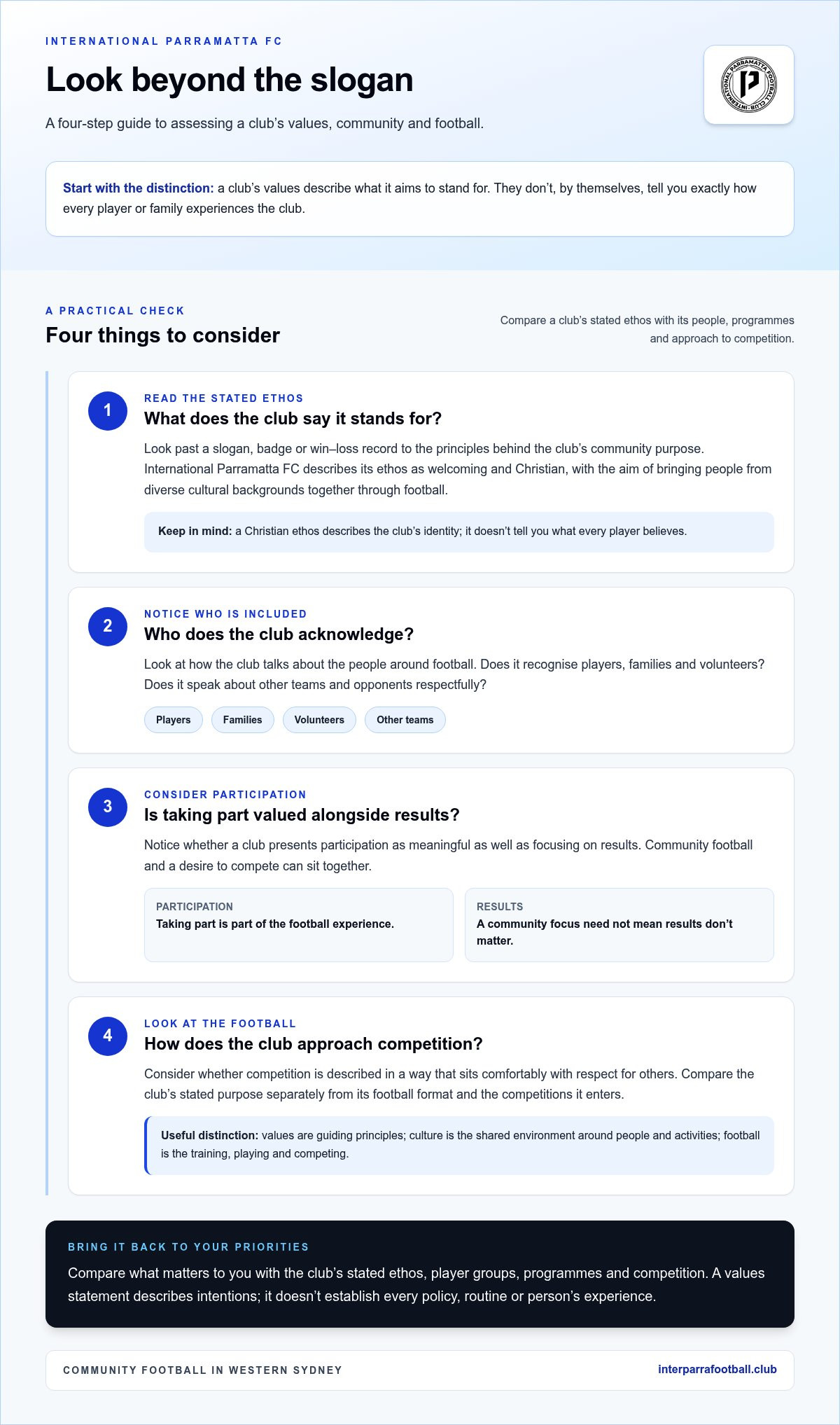
Choosing a club is about more than liking its principles on paper. Think about what matters to you or your family, then compare those priorities with the club’s stated purpose and football programme. This four-step approach can help you assess a values based soccer club western sydney using the information that matters to your decision.
To assess a club’s fit, identify your priorities, understand its ethos, explore its programme, then reflect on whether its purpose suits you.
Identify your priorities. Decide what you want football to offer. Your family might value a regular sporting activity, social connection or a community shaped by particular principles. Adult players may be looking for the enjoyment of competing as well as a sense of belonging.
Understand the ethos. Consider how the club describes its purpose and guiding identity. Read its words in context, separating what it states from what you might infer about individual beliefs or team experiences.
Explore the programme. Look at the types of football and player groups the club describes. Age range and competition participation provide useful background. Check how those details line up with the player’s age, interests and preferred style of football.
Reflect on fit. Compare the club’s stated purpose and programme with your priorities. Ask yourself which parts feel relevant, which are less important to you, and whether your judgement is based on information or assumption.
Questions that clarify a club’s stated values
As you read a club’s information, consider what it says about its purpose and ethos. How does it describe participation, community and competition? Does its stated identity speak to sport alone, or also to bringing people together? These questions help you understand the club’s intentions without treating a statement as a guarantee of a particular experience.
Keep your own preferences in view, too. A family focused on social connection may read a club’s community purpose differently from a player whose main priority is competition. Neither preference is the only right one. The useful question is whether the club’s stated aims make sense for what you hope to get from football.
For families, the choice may involve balancing a child’s interest in playing with the kind of community they’d like to be part of. Adult players can consider whether the club’s broader purpose resonates alongside the chance to train and compete. A values-led identity doesn’t replace the sporting side; both can matter.
International Parramatta FC serves Parramatta, Cumberland, Hills and Blacktown, with programmes for players from age three through adulthood. It offers regular season teams, summer soccer and holiday clinics, alongside participation in CFA Sydney competitions and independent tournaments. These details give you a practical starting point for comparing the club’s player groups and football options with what you’re looking for. For more local context, explore community football in Parramatta, then read about the ethos and community at International Parramatta FC.
Values-based football is not one-size-fits-all: common assumptions to reconsider
A values-led identity can mean different things to different people. It’s worth separating a club’s stated purpose from assumptions about its players, practices or the experience a particular team provides. No club’s values make it automatically better than one with a different identity; what matters is whether its purpose and approach suit your priorities.
That’s especially helpful if you’re considering a values based soccer club western sydney and trying to work out what its ethos means in practical terms. Treat the statement as useful context, then compare it with the football programme and competition participation. A club’s description gives you a starting point for your decision, while your own priorities determine what feels like a good fit.
Does a Christian club ethos mean football is only for Christians?
International Parramatta FC has a welcoming Christian ethos and aims to bring people from diverse cultural backgrounds together through football. That describes the club’s outlook and purpose; it doesn’t tell you what every player believes. The phrase alone also shouldn’t be taken as evidence of faith requirements or particular activities.
If the Christian identity raises questions for you or your family, consider what the club states about its ethos and whether that identity feels comfortable alongside your own priorities. You don’t need to assume that every member shares the same beliefs or experience. A thoughtful decision starts with what is stated, not guesses about individuals.
Can a values-led club still take competition seriously?
Yes. Community connection and competitive football can belong together. A club may value bringing people together while also entering organised competitions; those aims aren’t opposites. International Parramatta FC participates in CFA Sydney competitions and independent tournaments, providing context about its involvement in competitive football. That information describes the competition setting, not a particular team’s results or level of play.
Players can care about different things. One person may prize the social side; another may look forward to testing their skills in a match. A community purpose can make room for both interests without suggesting that every player has the same goals or that competition always takes priority.
As you weigh up a club, keep three ideas separate: its stated values, the football it participates in, and what you personally hope to gain. A Christian ethos isn’t a complete description of every player, just as competing doesn’t cancel out a community purpose. This balanced view helps you judge whether the club’s identity suits you without assuming there is one best fit for everyone.
Read more about the ethos and community football at International Parramatta FC when you explore the club.
International Parramatta FC: a values-led community football club in Western Sydney
For people looking into a values based soccer club western sydney, International Parramatta FC offers a local example with a clear community purpose. The club serves Parramatta, Cumberland, Hills and Blacktown. Its welcoming Christian ethos sits alongside an aim to bring people from diverse cultural backgrounds together through competitive football.
The club’s programmes span players from age three through adulthood and include male and female football. Its offerings include seasonal team registration, summer soccer and holiday clinics. Looking at the player groups and programme types can help you decide which parts of the club’s football are relevant to you or your family.
A local club built around community and shared football
International Parramatta FC began in Parramatta in 2018 as Ambassadors FC Parramatta, then took its current name in 2020. Its story connects local football with a wider purpose: bringing people with different cultural backgrounds together through a shared game. That aim forms part of the club’s identity, while each player’s experience remains individual.
Competitive football is part of that picture. The club participates in CFA Sydney competitions and independent tournaments, giving players a sporting setting alongside its community focus. These details show the kinds of football the club is involved in, without making claims about results or coaching standards.
For families and adult players alike, this mix can be a useful starting point for considering whether the club’s purpose resonates. You might value the chance to take part in organised football, the opportunity to connect with people from varied backgrounds, or the club’s stated Christian identity. Your priorities may differ from another player’s, and that’s a natural part of choosing a football community.
Explore whether the club’s ethos resonates with you
Consider these elements together rather than drawing conclusions from one detail alone:
Community purpose: Does the aim of bringing people together through football appeal to you?
Christian ethos: Does the club’s stated identity sit comfortably with your own values and priorities?
Age and gender range: Does the overall scope of its programmes sound relevant to the player you have in mind?
Competitive participation: Are CFA Sydney competitions and independent tournaments part of the football context you’re seeking?
These points can help you explore the club with an open mind, without assuming one description guarantees a particular outcome or that every player is looking for the same thing. A local football club can offer both a place to play and a community purpose to consider, whether you’re exploring options for a child or for yourself.
To learn more about the club’s programmes, ethos and community football, explore International Parramatta FC.
Take your next step towards local football
A search for a values based soccer club western sydney can be a starting point, not a decision you have to make all at once. Consider what you’d like football to add to your life or your family’s routine: time on the pitch, shared purpose, new connections, or a mix of these. That personal picture can help you explore a club with curiosity rather than pressure.
It may also help to talk together about what feels important, especially if you’re choosing for a young player. There’s room for different priorities, and the right fit is personal. Compare the club’s ethos with its programmes and competition participation to see how they sit alongside the kind of football community you hope to join.
Whether you’re returning to the game or thinking about joining for the first time, start with what matters to you and let that guide your next step. Explore International Parramatta FC’s community football programmes.
Frequently Asked Questions
What is a values-based soccer club?
A values-based soccer club is one where guiding principles help shape its sporting and community purpose. If respect matters to you, for example, look at how the club talks about teammates and opponents, not just its tagline. A values statement helps you understand the club’s intentions, while its player groups and competition details give you more context about the football on offer. Together, these details provide a clearer basis for comparing local options.
Does a Christian football club mean players must be Christian?
A Christian identity alone doesn’t establish that every player shares that faith or that football participation has a faith requirement. If you’re considering a values based soccer club western sydney, read the club’s description as information about its ethos, rather than a statement about each player. You can then consider whether that identity feels comfortable for you or your family without assuming what an individual believes or experiences.
Can a values-based soccer club still be competitive?
Yes. A club can care about community and still take matches and team participation seriously. Values don’t determine a competition’s level, results or playing standards, so consider those separately. You may enjoy the challenge of fixtures while also wanting a sense of connection with the people around your team. Those priorities can sit together.
How do I know whether a soccer club’s values are a good fit?
Compare the club’s stated purpose with what matters most to you, rather than trying to find a perfect match on every point. Write down your priorities, such as a child’s enjoyment, regular competition, social connection or a particular ethos. Then consider which details are clearly stated and which are assumptions. This gives your family a practical way to discuss the choice and decide what feels comfortable.
Are values-based soccer clubs only for children?
No. Community football can be for adults as well as children, and International Parramatta FC’s programmes include adult players. An adult considering joining might weigh up the football itself, the club’s community purpose and how its ethos fits their own priorities. Families can also consider football for a child, themselves or more than one person.
What does multicultural community football mean in Parramatta?
It describes people with different cultural backgrounds sharing a local football setting, rather than suggesting everyone has the same story or experience. The common ground may simply be a shared interest in playing and following the game. For someone new to Parramatta, a team can be one way to meet people around that interest, while each person brings their own background, language and reasons for taking part.
Is a values-based soccer club different from a social soccer competition?
They describe different things. A values-based club is identified by the principles it says guide its community and sporting purpose; a social soccer competition describes a style of play generally organised around recreation. The two ideas can overlap, but they aren’t synonyms. A club’s values don’t tell you whether its football is informal or competitive, so consider the format separately from the ethos when deciding what suits you.



Comments